Tuesday, December 14, 2010

Dreaded freeze

We have been experiencing very strange weather this year. First we had a record-breaking cold winter last year, then a record-breaking warm spring and summer, then record-breaking warm fall, with record-breaking drought.

Now we are having record-breaking cold this early in December with overnight freezes ! We normally only experience occasional frost during mid January !

Last night the temperature must have dipped to well below freezing. This morning I took these pictures of icicles hanging from several plants.

Ice on the carissa (natal plum)


Ice on the sapodilla

We are expecting freezing temperatures again tonight. Only time will tell which plants will die as a result. So far, it looks like the bananas, sanchezias, some of the papayas .... Luckily I brought my little nursery inside the garage and will keep them there again tonight. I've been growing some of these plants for 3 or 4 years and can't risk loosing them. These include blue grape, dragon fruit, grumichama's, prickly pear, cycads, starfruit, various aloes...

My heart goes out to all the farmers all over Central and South Florida who will be devastated by this early frost. In St. Lucie county the damage to citrus crops alone could run in the 100's of millions of dollars.

This week I spoke with a tree farmer that is still recovering from last winter's freeze - he lost more than 2100 valuable palm trees worth hundreds of thousands of dollars.

I hope and pray all is not lost.

Aloe thraskii update - recovers from crown rot

During the hot humid summer months, my Aloe thraskii that i had been growing for about 4 years suddenly succumbed to crown rot.

I removed the rotten crown and just left it. Shortly afterwards we hit one of the driest spells in recent history.

I suspect the dry hot weather enabled it to completely recover and it started pushing out new growth. It is now busy pushing out flower stalks ! I've never seen an Aloe thraskii in bloom so I am ultra excited. So if you have an Aloe thraskii with crown rot, leave it and it will most likely recover.

Aloe thraskii recovering from crown rot
Unfortunately the timing sucks. We've had the coldest snap since 1937, last week we had close to freezing temperatures and I didn't cover any of my plants, luckily so far it only looks like the sanchezia (as usual) was badly damaged.

Last night we had sub-freezing temperatures, luckily I took the time to cover the aloe with old towels. I didn't have time or material to cover anything else, so now I am waiting to see what will die and what will survive. We are expecting freezing or close to freezing temps again tonight.

Aloe thraskii flowering 2 months after crown rot
Protecting Aloe thraskii against from frost

Gardeners block

I often wonder if my fellow gardeners also sometimes hit a period of not knowing what to write on their blogs.

Its not that nothing has been happening in the garden, it is either I'm too busy with work and family or feel what I've been doing is not of enough importance to tell the whole world about it.

I suspect there could also be more to it, I spent the first 4 years working feverishly - almost every spare moment I had was dedicated to the garden. Then as the vacant space became less and less and I had more and more trouble finding a spot for that new plant, I found myself spending less and less time in the garden and subsequently visiting garden centers or even buying seed less and less. After burning myself out trying to keep up with mowing, edging and gardening, I finally gave in and paid someone to mow and trim.

The summer was also so terribly hot and humid and that made matters even worse. Coupled with our record-breaking heat, we also had record-breaking drought. Last time I heard we were more than 6 inches below normal just since the beginning of October. It is well reflected on my water bill. It has more than doubled in the last couple of months.

To make matters worse, the heat lingered on and on and I felt even less motivated to start preparing the veggie patch. We normally start our "summer" veggies around mid October, but we were still having 90+F days and no rain, so I waited patiently. It finally started cooling down ever slightly by mid November.


I finally got out of my slumber and used the ugly trellis material I removed from the patio to create a "fence" around my new "out of sight and out of mind" veggie patch. I created three planting beds, fertilized with Milorganite.

Then I had problem getting water to it, bought some soaker hoses, laid them out and attached those quick connectors so I can take the garden hose and quickly just clip it in to water the entire veggie garden.

So its not ideal, but at least now I can turn on the kitchen timer, turn on the water and remember to turn it off.

Next step will be to install a poly pipe to take water all the way to the back (about 130 feet), attach it to a multiple manifold so I can still use the hose and/or spigot, attach a timer and forget about it.

Tuesday, October 12, 2010

Finally : wild edible mushrooms in my backyard

I've been lamenting about the bounty of giant, dinner sized toxic mushrooms (Chlorophyllum molybdites ) springing up all over our neighbourhood after rain.

I've been wishing I could seed my yard with edible mushrooms instead, then I discovered to my amazement these giant white puff balls. I was a little hesitant and did a lot of research and finally without a shadow of a doubt identified these as the "The Giant Puffball", Calvatia gigantea.

I washed my first one carefully, then peeled the skin off to remove the black soil, then cut it into 1/2 inch thick "steaks", then fried them in butter with garlic and herbs.
 It was delightful. My wife said: "I'll see if you're still alive tomorrow, then I might consider tasting it". I fried mushrooms for myself a couple of times when she finally gave in and tried it, she loved it and so did the girls, now when I find a newly "hatched" puffball, we add it to whatever dish we're making, last time my wife added it to a delicious pasta dish, it made the dish creamy and very tasty.

Disclaimer: Please do not gather and eat any mushrooms unless you can be 100% sure they are non-toxic.

Protecting Meyer Lemons from birds : Update

Even though the foot socks didn't help to protect my pomegranates from the leaf footed bugs, they sure scared the birds away from my Meyer Lemons. Even though the lemons outgrew the socks - and they teared, it still kept the birds away.

We've been having as many lemons as we need, plus giving away some to all guests. The first crop is barely ripening and I see the tree starting to bloom again.

These lemons are delightful, not as sour as other lemons, cut them into wedges, salt them up and eat away !

Monday, October 4, 2010

Trust your first instincts


Indian Jujube

I really created a lot of work for myself by planting plants in spots I knew I shouldn't have.

I went to my favourite rare fruit nursery once, and wasn't sure what I wanted to buy, so I asked for a small tree with great tasting fruit. Well, I ended up buying an Indian Jujube tree. I walked around the yard and just couldn't find a spot that I wanted to give up for the jujube since I didn't know what it would taste like. I finally decided upon a spot next to my developing rock garden. I knew right there and then it wasn't the right spot but planted it nonetheless.

Turns out the tree is is not small  - its a very fast and aggressive grower, its has a scrawny habit and when the trunks are laden with fruit, they bend down, covering a very large area and makes it impossible to mow or weed underneath. The trunks are so long that when they sag down, they cover the rock garden too !

The other problem, no-one in my family likes the fruit, including myself.

The branches are also cover with nasty hooks that makes working around and with it nasty. This tree also seems to be one of the Sri Lanka weevil's favourite food plants.

Horse Radish
So I had to make a tough decision, should I keep the tree as it is rather pretty regardless of the bland tasting fruit and nasty thorns ? After thinking about it for months, I finally took the plunge. While I had my chain saw pruner attachment on my weed whacker, I decided to take it down and also chop down the horse radish tree (that I also knew I shouldn't have planted where I did).

Rock garden with stump of Jujube behind it
After all this hard work and money wasted I'm back to where I was before I planted these two trees. I've since learned that its better to give away plants that you don't want, than to plant them in the wrong spot and having to end up spending a lot of sweat and hard work to remove them later when they do become a problem.

Sunday, October 3, 2010

Read this before you plant that yellow passionfruit

Yellow Passionfruit vine eating up Travellers Palm
So you're thinking of planting a yellow passionfruit also known as lillikoi, or Passiflora edulis var flavicarpa ?

I already had so many different tropical fruits and despreately wanted a passionfruit. I read that the purple fruited variety is very susceptable to nematodes here in South Florida's sandy soil, so I found some Brazilian yellow round passionfruit seeds. Unlike the other passionfruit seeds I had bought, thse seeds readily germinated and grew very fast.

I found 8x4x4 solid cedar posts on sale at Home Depot, bought the wire, metal connectors and all the other hardware to construct my two wire trellis as all the books and online sources instructed, only this is not near enough to support a yellow passionfruit vine.

I planted 2 containers, I had two vines, the other one. Within one year, these three plants had covered the fence, grown into my neighbour's trees, covered the whole area in the picture to a heigth off about 3 feet, started smothering my travellers palm mango, litchi, fig, papaya tree, in short, anything within its grasp.

Feeling sorry for it and hoping for some delicious fruit, I left it to its own devices. I should have followed my first instincts and gotten rid of it sooner than later. It flowered on and off but never set a single fruit.

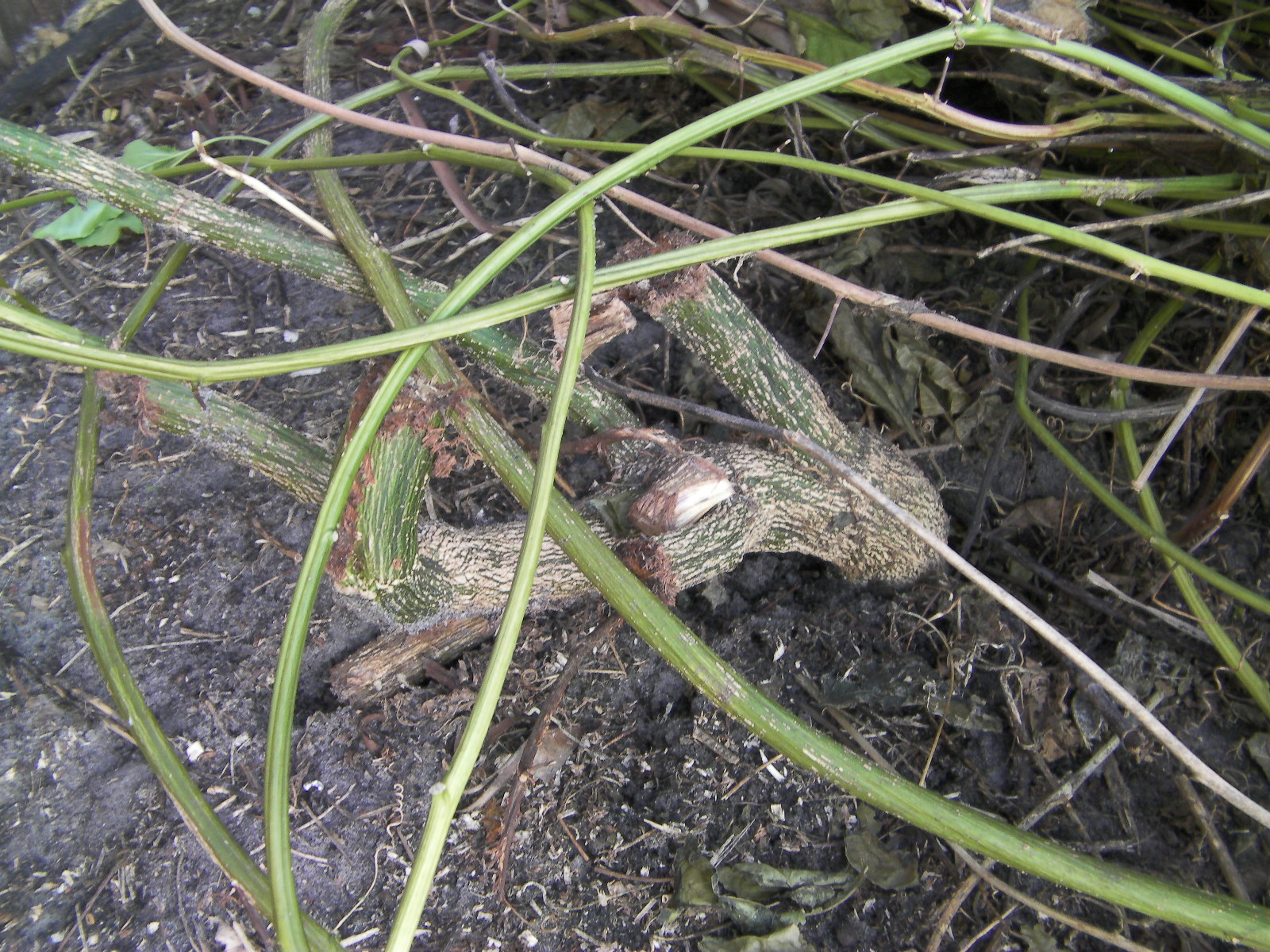
1 year old yellow passionfruit vine stem
4 weekends later and this area is now clear, was covered to top of fence, and rest up to 4 feet tall
Some of the dead vines heaped onto a pile
I spent the last 4 weekends getting rid of this invasive vine. Seriously, this is not something I wish on my worst enemy. To remove this vine was hell, it kept on looping aorund the head of the weed wacker and every few seconds I had to untangle it, I also used my pole pruner on it, it even  managed to get into the chain saw enclosure and brought everything to a halt and I constantly had to pull the vine out to get it going again. Today I had to cut the strands with a pruner in order to untangle it from the wires and clear the area. I will not plant another passionfruit here as long as I live here. Maybe not even the tamer purple variety.

The cedar posts rotted, so much for "rot resistant cedar", guess nothing can withstand the hot, humid and wet Florida summers.

8x4x4 cedar fence post after 1 year in ground
If you really must plant this vine, make sure you have enough space and please do yourself a favour and keep up with it. As soon as you see it grow into your other beloved plants or trees, cut off those tendrils and keep a close watch on it, before you know it, it will completely cover everything in its path.